
Rohingyas are a Muslim community who are in minority that lived in Myanmar. This group has faced violence in Myanmar because of their religion. The various policies of the government are against the minority as they are called to be as ‘Islamophobic’ which in turn has led to the fleeing of many Rohingyas to places like Bangladesh, Malaysia and Thailand. They have fled their homes in large numbers due to violence against them and live in refugee camps. The Rohingyas practice ‘Sunni Islam’ and majority of them live in the Rakhine state. They are regarded as ‘illegal’ and ‘unwanted’ by the society. The issue brief will aim to address the engagement between instability and religious tensions in Myanmar that have contributed to the emergence and propagation of extremist Buddhist ideologies and the kind of role the extremist ideologies play in the persecution of the minority in the country.
Understanding the situation in Myanmar
The Rohingyas are regarded as one of the most discriminated minorities in the world. They represent the Muslim population in Myanmar which is one of the many minority groups in the country along with Christians. The Burmese Government and the Buddhist Community in Myanmar are against the minority and hence they had to leave their homes and flee to far away countries like Malaysia and Thailand. They are different from Buddhists as they have their own language and culture and live in the Rakhine state of the country. Buddhism is a dominant religion in Myanmar and the Buddhists monks and people propagate and indulge in the ideologies of Buddhism.
The Muslims are the most persecuted minority in Myanmar and they need protection. The fight is between the minorities and the Buddhist community of Myanmar. There are many laws that are made to target the minorities in specific. For example, under the ‘Thein Sein’ Government, Rohingyas have faced killings, violence and denial of citizenship. The situation became worsen when a Buddhist girl was raped by Rohingya men in the year 2012, leading to chaos and communal violence. Myanmar was ruled by the British Empire in the 19th century. In the olden times, the Britishers made fake promises to the Rohingyas to grant them separate land in return for their support during the wars and the minority had supported them during World War I but the Britishers didn’t grant them a sovereign land afterwards.
The Rohingyas have been fighting for their rights and individuality ever since as they are regarded as ‘foreign’ and ‘unwanted’. The Burmese Government denied their citizenship in 1982 which made them forced to flee in a large amount to neighbouring countries. Their conditions have been worse as they are homeless and due to the adversities faced had to live in refugee camps.
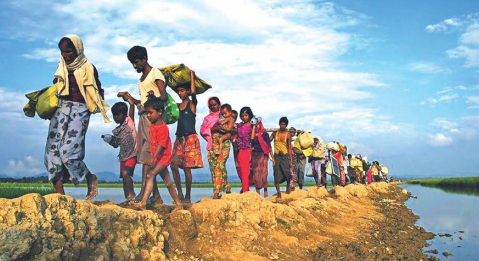
History of the Rohingya
The Rohingyas belong to the Indo-Aryan decent of ethnic minority in the Rakhine State. It is said that they are related to the Indo-Aryan race that belonged to India and Bangladesh. There was a fear among the Burmese people about losing their identity to the outsiders since the olden times. When democracy came in the year 2011, it led to hatred speeches and violence against the minorities which led to a negative impact of democracy by the junta and monks. The Buddhist ideology is such that they believe that the Islam community in the country will take over Myanmar and the Buddhist or Theravada culture will vanish out of the region. The military or the junta provides support to the Burmese government and hence they are able to publicly degrade other religions and make them feel inferior.
The authors Ye Myo Hein and Lucas Myers in the article ‘Myanmar’s Military is a Regional Destabilizer’ speak about Myanmar being in a state of civil war since their independence from the United Kingdom in 1948. The country’s military is known as “Sit-Tat”. The article explains the reader about the role of the military in exaggerating political instability and religious tensions in Myanmar. For example, the Coup of February 2021 is the best example of a country progressing to suddenly becoming a “failed state”.
The authors convey that as long as the military will be in power in Myanmar, the country will be in a state of coup and instability. The authors then talk about the ‘junta’ party of Myanmar’s complaining nature and rather should understand the “Sit-Tat” instead. To understand the nature of instability of Myanmar means to “recognize the junta for what it is”
says the authors.
The military of Myanmar has been recognized and claimed by the authors as “Destabilizers” as they are spreading hatred and violence. They have been regarded as the reason for the unstable situation in the country. Then there are instances given about the issues where SitTat had instigated ‘The Rohingya Crisis’ in the year 2017. The country has more than hundred ethnic groups. The country has been under the rule of “an oppressive junta” from 1962 to 2011. It speaks about the Rohingya Movement wherein thousands of Rohingyas had fled to countries like Bangladesh. The free elections of 2015 and a democratic government led by the famous Aung Sang Suu Kyi’s party.
The current situation in Myanmar is leading to a disaster in Human Rights. The people of Myanmar had literally cried for help against and carried out massive peaceful protests against the military. The military used force to oppress the peaceful protests and protestors. The COVID-19 pandemic had aggravated the situation and the article speaks about Tatmadaw which is the country’s powerful institution. So, Myanmar is in critical need of help for humanitarian assistance.
Finally, the authors speak about the environment post the 2021 February Coup in Myanmar which made the country turn into “a failed state”. Myanmar has been regarded as a “black hole of instability and chaos”. The affects of the crisis in Myanmar have acted as spillovers in South East Asia.
Buddhist Extremism and leaders
In the article named, ‘Extremism Rises Among Myanmar Buddhists’ by Thomas Fuller, he speaks about the importance of ‘religion’ in Myanmar and the minds of the Burmese people. He begins speaking about the history of Buddhism and speaks about Theravada Buddhism. He then starts defining the term ‘ethnic minorities’ and says that Myanmar is a diverse country in terms of its religion. He explains the reader in detail about the various ethnic groups in the country
He later laid emphasis on the emergence of Buddhism as the sole religion made by the military dictators. He speaks about ‘Buddhism’ as a “tool for dictators”, to remove the remaining ethnic minorities from the country. The article overall speaks about the use of religion as imposing Buddhism as the sole religion of Myanmar and being extremely hostile towards other minorities in the country.
He also spoke about Christianity being a dominant religion along with Buddhism in Myanmar and both the religions being hostile and violent towards other ethnic minorities. He talks about the preferences of the Burmese government which is that ‘Theravada Buddhism’ has been
preferred by them.
There have been many instances of discrimination and violence against other religions that had been registered, for example, Christian Solidarity Worldwide (CSW) had released a report on January 23 in 2007, showcasing government’s restrictions and discriminatory acts against the Christian minorities in Myanmar.
Thomas Fuller, tried to say that Buddhism or Theravada Buddhism has been regarded as the sole religion to be followed in Myanmar and by all of its people. Any other religion and people in the country have therefore faced many discriminatory acts and violence by Buddhist people, the Burmese government, and military leaders of Myanmar.
Buddhist Extremist leader and the Ma Ba Tha Movement
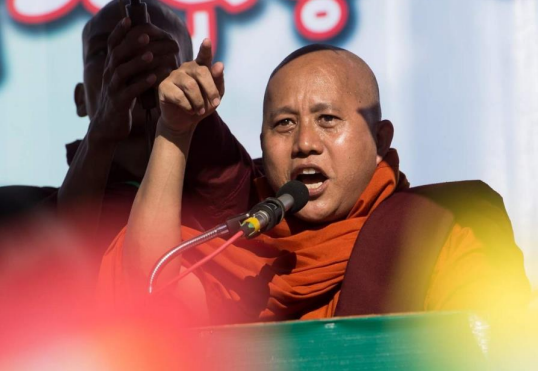
Ashin Wirathu is an extremist Buddhist leader of Myanmar propagating violence and hatred publicly in his speeches against the minority communities. It is astounding and fascinating to know this information as the religion of ‘Buddhism’ is known to be a religion promoting and spreading peace and harmony in all the people around the world. But, there are Buddhist leaders brainwashing the minds of their followers and the people of Myanmar.
He has been regarded as a “controversial Buddhist Monk” whose sayings and teachings have been regarded to be called as ‘Islamophobic’ and he propagates an anti-muslim rhetoric. Even the military junta of the country is following the wrong doings of the Buddhist community of the country. He was imprisoned for the same and released after some time from jail. His voice became prominent in the year of 2011 after the violence between the Buddhists and the Rohingya Muslims.
The Ma Ba Tha is an organisation comprising monks and nuns. It is also known as the 969 movement and its main agenda is being anti-muslim and protecting Buddhist culture. The three numbers ‘9 6 9’ each symbolize the teachings of Lord Buddha and Buddhism. The leader of the movement is Ashin Wirathu.
The unstable situation in Myanmar is arising out of religious atrocities that has led to the fleeing of many refugees in Bangladesh and elsewhere numbering to nearly one million. They struggle with the trouble of getting integrated into a third country and are bound by many hardships. The Rohingyas existing in Myanmar face threatening life conditions similar to that of concentration camps and face denial of access to basic means to sustain.
It is shocking and hard to digest by the people across the globe to watch and hear about Buddhist leaders to brainwash and provoke the junta writing and posting hateful Islamophobic sentiments in the people on online platforms. There was an incident in 2016 wherein there was a brawl among Rohingyas and Burmese police along side the Bangladesh border which has said to be the starting point of the fight between them.
An important incident of violence against minorities was seen with the formation of the ‘Right Wing Dharma Squads’ which was formed in 2019. The participants of the group are mainly Buddhists who discuss about nonsensical issues like Buddhism has been deteriorating in Myanmar due to minorities and discuss hatred or disregard against other communities as well like LGBTQ+ and Black Lives.
Social media platforms like ‘Facebook’ have been used as a medium of spreading ‘hatred’ and ‘violence’ in the public by Buddhist extremist nationalists and in provoking anti-Muslim sentiments via hate speeches. This includes threatening the Muslims and the entire nation having Buddhist majority. The Burmese government has favoured them by barely refusing to ban the promotion of their activities and giving them a state protection. It is clear that hatred speeches need to be banned. There should be steps from the Burmese government that should aim at banning the use of hatred speeches and creating a more inclusive environment for independent journalism and the media can be used to cultivate empathy instead of violence.
The Way Forward
From the above discussions it is clear that Myanmar is a controversial and a problematic country existing due to the extreme and violent acts of certain members of the society who are Islamophobic. The junta and the Buddhist monks who are in majority are spreading hatred and discrimination publicly in the country and on an international level as well via their speeches
The trauma and violence have been unsuccessfully handled by the ASEAN members. ASEAN has been failed in handling two issues which are the situation in Myanmar and the South China Sea Dispute. The cause of the blunder in Myanmar has led Rohingyas to flee the country in large numbers and go elsewhere and live in refugee camps, the 969 or the Ma Ba Tha Movement has led to an increase in anti-muslim sentiments in the minds of people in the country, there are inter-communal and religious tensions in Myanmar.
The various leaders from South East Asia have “strongly condemned the continuing violence in Myanmar” by blaming all the military generals involved in the February military coup in the country in the year 2021.The leaders have tried to take some steps in handling the situation by “urging the Myanmar Armed Forces in particular” and all the people involved to de-alienate violence in Myanmar. The leaders have said that they have “condemned” the situation in the country
ASEAN has failed in the Myanmar violence and has not been able to take any persistent and firm steps yet and the Myanmar’s foreign ministry has rejected all ASEAN statements saying that “The views are not objective and decisions are bias and one-sided.”]
On April 24, 2023 completed two years “since ASEAN agreed on the Five Point Consensus in response to the military coup in Myanmar”. The military has clearly denied all calls from anyone for stopping the violence.
According to Amnesty International,
- The special envoy and delegation should visit Myanmar to meet all parties concerned.
- There should be immediate halt on violence in Myanmar and all parties should exercise restraint.
- There should be constructive dialogue discussions that need to be held among all parties concerned, which should initiate a peaceful solution in the interests of the people.
- A special envoy of the ASEAN Chair should facilitate mediation of the dialogue process along with the assistance of the Secretary General of ASEAN.
- ASEAN should provide humanitarian assistance through the AHA Centre
The military should immediately stop dropping aerial bombs and risking the lives of the citizens as it is a violation of humanitarian law and release all Rohingyas who have been detained to express their freedom by a movem
Conclusion
There is a lack of togetherness and nationhood in Myanmar as clearly the Buddhist nationalists and the military of the country brainwash the nation to only abide by Buddhist ideologies and follow them while eliminate minorities like Rohingyas from the country. It is evident that the Buddhist monks have been successful in doing so as millions of Rohingyas have fled to neighbouring countries seeking shelter and food henceforth living in refugee camps like nomads. Leaders like Ashin Wirathu have given many hateful speeches publicly against the minorities and have used social media platforms to eradicate the minorities from the country while propagating Buddhism. The nationalist leaders and the junta should stop the act of violence against other religions and promote peace and harmony just like what their
religion ‘Buddhism’ actually means and stands.
- REFERENCES
- Albert, E. (2020, January 23). The Rohingya Crisis. Council on Foreign Relations. https://www.cfr.org/backgrounder/rohingya-crisis
- Szurlej. (2016, December). Preventing Genocide against Rohingya Muslim Minority in Myanmar. Research Gate, 29.
- Myanmar Rohingya: What you need to know about the crisis. (2020, January 23). BBC News. https://www.bbc.com/news/world-asia-41566561
- Abdelkader, E. (n.d.). The history of the persecution of Myanmar’s Rohingya. The Conversation. https://theconversation.com/the-history-of-the-persecution-of-myanmarsrohingya-84040
- Hre. (2013). Religion: A Tool of Dictators to Cleanse Ethnic Minority in Myanmar? . Victorian Chin Baptist Church.
- Myanmar’s extreme Buddhist nationalists. (n.d.). https://www.lowyinstitute.org/theinterpreter/myanmar-s-extreme-buddhist-nationalists
- International Centre for Political Violence and Terrorism Research, & Gunasingham. (2019, March). Buddhist Extremism in Sri Lanka and Myanmar: An Examination. JSTOR, 11, 7. https://www.jstor.org/stable/pdf/26617827.pdf?refreqid=fastlydefault%3Aeab2f276258fed48423ec5f8d7e5f637&ab_segments=&origin=&initiator=&acceptTC=1
- Hein, Y. M., & Myers, L. (2023, December 22). Opinion | There Is Finally Hope of Ousting Myanmar’s Military Junta. The New York Times. https://www.nytimes.com/2023/12/22/opinion/myanmar-resistance-military.html
- Myanmar. (2023, January 20). Human Rights Watch. https://www.hrw.org/worldreport/2023/country-chapters/myanmar
- Fuller. (2013, June 20). Extremism Rises Among Myanmar Buddhists. The New York Times.
- Christian Solidarity Worldwide . (2007, January 23). 33rd Session of the Universal Periodic Review Democratic People’s Republic of North Korea (DPRK) Submission by CSW Christian Solidarity Worldwide) . Christian Solidarity Worldwide , 8.
- Artinger, B., & Rowand, M. (2021, February 16). In Myanmar, Buddhist Monks Preach Nationalism. Foreign Policy. https://foreignpolicy.com/2021/02/16/myanmar-rohingya-coupbuddhists-protest/
- Wirathu: Myanmar military releases firebrand Buddhist monk. (2021, September 7). BBC News. https://www.bbc.com/news/world-asia-58471535
- Bookbinder, A. (2013, April 9). 969: The Strange Numerological Basis for Burma’s Religious Violence. The Atlantic. https://www.theatlantic.com/international/archive/2013/04/969-the-strange-numerologicalbasis-for-burmas-religious-violence/274816/
- Myanmar: What sparked latest violence in Rakhine? (2017, September 19). BBC News. https://www.bbc.com/news/world-asia-41082689
- Buddhist Majoritarian Nationalism in Myanmar. (2023, December 18). South Asia@LSE. https://blogs.lse.ac.uk/southasia/2023/12/18/buddhist-majoritarian-nationalism-in-myanmar/
- Crystal, C. (2023, September 7). Facebook, Telegram, and the Ongoing Struggle Against Online Hate Speech. Carnegie Endowment for International Peace. https://carnegieendowment.org/2023/09/07/facebook-telegram-and-ongoingstruggleagainstonlinehatespeechpub90468#:~:text=In%202018%2C%20the%20United%20Nations,hate%20speech%20in%20the%20country.
- Myanmar’s Crisis Looms Over the ASEAN Summit. (n.d.). United States Institute of Peace. https://www.usip.org/publications/2023/09/myanmars-crisis-looms-over-asean-summit
- Kurlantzick, J. (2022, August 29). ASEAN’s Complete Failure on Myanmar: A Short Overview. Council on Foreign Relations. https://www.cfr.org/blog/aseans-complete-failuremyanmar-short-overview
- The Myanmar crisis shows ASEAN’s irrelevance. (2023, September 10). Washington Post. https://www.washingtonpost.com/opinions/2023/09/10/asean-fails-help-myanmar/
- Myanmar: ASEAN needs to address its failing approach to the crisis in Myanmar following the military coup – Amnesty International. (2023, April 24). Amnesty International. https://www.amnesty.org/en/documents/asa16/6687/2023/en/
- Al Jazeera. (2023, September 6). Myanmar rejects ASEAN statement condemning violence as ‘one-sided.’ Al Jazeera. Retrieved January 26, 2024, from https://www.aljazeera.com/news/2023/9/6/myanmar-rejects-asean-statement-condemningviolence-as-one-sided