
A REVIEW BY VINITHA D P
The following quote piqued my curiosity to learn more about Burma: “Burma’s history is not one of static isolation but of constant interaction with the world, even if that world has often seemed very far away” (Thant Myint-U, 2019, p. 25).
The book, The Hidden History of Burma: Race, Capitalism, and the Crisis of Democracy in the 21st Century, is an interesting and insightful work of literature on Burma/Myanmar. It is a book that explores various aspects of the country’s history, including religious and ethnic groups, migrations from neighbouring regions, and the impact of British colonization, all of which have contributed to shaping modern Burma. Besides the Introduction, it has nine very lucidly written chapters. Notably, the authors, Thant Myint U, emphasizes the use of the term “Burma” rather than “Myanmar”, highlighting its historical significance. In the earlier chapters, some such confusions and debates around names are highlighted. For example, the use of the word “Rohingya” to describe the Muslim minority in Arakan; older names of places, like “Arakan” instead of Rakhine. The author tends to deliberately retain those to reflect the historical continuity.
Particularly interesting is the fact that Thant Myint U himself has deep historical connect with Burma. He is the grandson of the former Secretary General of the United Nations, U Thant (from Burma). This background gives him some unique perspectives and provides him with deep connection and authenticity on the subject at hand. The author has personally witnessed the transition of the country over decades, enabling him to observe developments closely and offer insights shaped by personal experience. Additionally, Thant Myint U’s prior works such as The River of Lost Footsteps: A Personal History of Burma (2006) and Where China Meets India: Burma and the New Crossroads of Asia (2011), have established his reputation globally. Added to this is his Western education at both Harvard and Oxford Universities, his lived experiences in Thailand and other places that provide valuable meaning to his writings. Thant Myint-U is currently associated with the Yangon Heritage Trust as its Chairman. This reputation allows The Hidden History of Burma to resonate with both Western scholars and Eastern readers seeking nuanced perspectives.
Thant Myint-U, being an experienced historian, ensures that he does not solely blame the military coup (1962 military coup led by General Ne Win ) for Burma’s downfall. Instead, he highlights other underlying factors that played significant roles. He states, “I began to understand clearly that the roots of Burma’s problems don’t lie in military dictatorship alone, but in its peculiar nationalism, which has led to war, isolation, and impoverishment. What Burma needed was not just a regime change, but a more radical process of transformation”. (Thant Myint-U, 2019, p. 12)
Another interesting element of the book is that the author introduces various characters with a detailed overview of their past, making it easier for the readers to grasp how some of the ideologies of people were shaped. For example, in Chapter 3 (pg. 88–90), he discusses student leader Min Ko Naing, whose activism during the 1988 uprisings stemmed from years of witnessing political oppression. Similarly, Moe Moe Myint Aung’s past experiences of rural poverty shaped her efforts towards the community led development. The author writes about various inspiring women leaders such as Aung San Suu Kyi, Moe Myint Aung, Noeleen Heyzer, and others. Importantly, he remains unbiased when it comes to gender.
The language used in the book is clear and accessible, which enhances comprehension. Thant Myint U skilfully ties Adam Smith’s concept of the “invisible hand” to the actions of a Buddhist monk helping the Rohingyas. As a historian, he does not restrict the book to just facts and details; he weaves in personal stories of ordinary people, making the narrative more relatable and engaging. In chapter 7 (pg.197-200), he recounts the struggles of a fishermen whose livelihood was destroyed by military land seizures, which highlighted struggles faced by common people because of political decision. These small narrations helped the reader connect with Burmese history not only intellectually but also empathetically.
The book’s context is well-suited to the time it was written in. But, it does not address more recent issues in Burma, which might shift the narrative in certain aspects. However, it still provides valuable insight into the historical context of Myanmar, offering a deeper understanding of the country’s past. The book is aimed at individuals interested in learning more about Southeast Asia, especially those who want to view the world from a Southern perspective rather than a Western one. It is particularly suited for readers curious about the region’s culture, religion, ethnicity, and the everyday lives of its people.
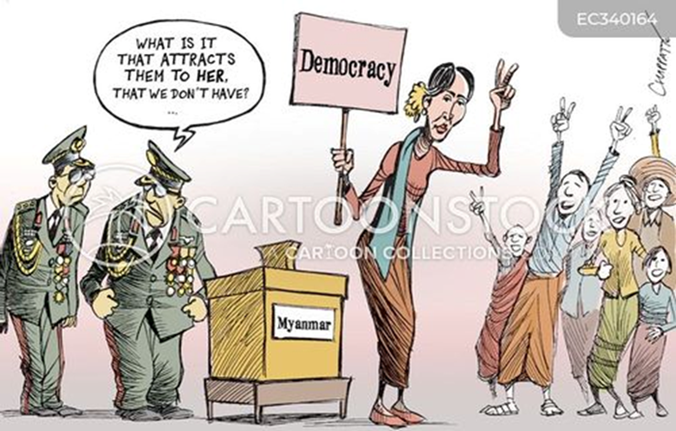
Hidden History of Burma briefly explores the ideological shifts that have occurred in Burma over time, focusing on the struggles and sacrifices the country has endured in its pursuit of peace. A key figure in the narrative is Aung San Suu Kyi, the Nobel Peace Prize winner, whose personal sacrifices, and advocacy for democracy demonstrate how one individual can influence society. Her connection to the West helped bring global attention to Burma’s challenges, embodied by her famous quote, “Use your liberty to promote ours“.
The book also highlights the significant impact of neighbouring countries, using the Tiananmen Square incident in China as an example. This protest inspired Burmese students to rise against their own communist regime, illustrating the domino effect of how one nation’s ideologies can influence others.
Amid these struggles, the author emphasizes the neglect of the West and the United Nations, particularly their failure to provide adequate support or foster trust in critical situations, leaving ordinary people to suffer. For example, during crises like Cyclone Nargis in 2008, local NGOs and organizations could have played a crucial role, but mistrust in the West stood as a barrier to effective aid. The delayed response from the U.S. in publicizing the disaster reflects the West’s hypocrisy in Chapter 2 (pp. 64–65).
Burma has also found itself caught between the competing influences of China and the West, with even members of its own parliament divided, slowing the country’s progress. The book examines how small cycles of corruption can deeply damage the economy and critiques capitalism, suggesting that while it may spur growth, it does little to address issues at the grassroots level. Despite achieving a degree of peace, Burma is still referred to as an “unfinished nation“. Burma has been a ground of competition between the West and China, with even the members of its own parliament divided degrading the country’s progress. The author has explained this tug-of-war in Chapter 9 (pg. 245–252). The author examines the parliamentary debates and the split between Pro–Western reformist and Pro–China pragmatists.
Some critiques of the book may include that, while the author uses simple language for ease of understanding, he frequently shifts between different timelines, which can disrupt the flow of reading. Additionally, although he explains the plight of the Rohingya Muslims, he overlooks the situation of the Rohingya Hindus, who are also part of the Rohingya community. Furthermore, while he discusses several neighbouring countries, there is a noticeable gap in his coverage of Burma’s relationship with India, despite it being a key neighbouring nation.
In conclusion, The Hidden History of Burma uncovers the lesser-known truths about Burma that the world has overlooked. Thant Myint-U highlights these hidden facets of the country’s history, revealing the deep struggles Burma has faced in its quest for peace and freedom. The book goes beyond political events, offering insight into the underlying forces that have shaped the nation. It explores the intricate and painful journey Burma has undertaken to escape dictatorship, nationalism, and external influences, shedding light on the many sacrifices involved. Furthermore, the book critiques the role of international bodies like the United Nations, questioning their effectiveness in addressing Burma’s needs. It encourages readers to move away from a predominantly Western worldview and examine the challenges faced by nations like Burma through a different lens. This shift in perspective is essential for understanding the realities of Burma and similar countries undergoing profound changes, fostering a more empathetic approach to global issues. Today, Myanmar is in a churn. Since the Coup of 2021, things have changed. Yet, there are structural and historical continuity, all of which finds some form of explanation in the book.